
Touching a Nerve... Literally
Risks of nerve injury when performing ultrasound guided nerve blocks


If you know me - you know I love the ultrasound machine, as do most EM providers out there. But there also exist some people in EM who have not accepted ultrasound’s love into their hearts, and that’s fine, but if I’m supervising you doing any procedure in an appropriate patient where we can accomplish targeted analgesia/anesthesia without sacrificing tissue geography, airway reflexes, and mental status, I sure as heck am going to recommend a nerve block. So of course while walking someone through one of these recently, they asked the poignant question: “What happens if I hit the nerve?”. To be frank - I said what has always been said to me “Nothing really. They might feel an jolt, but it’ll pass.”
And there it is. I said something that has always been said to me. I’m just a sheep. But not anymore of course, because I went and had to look it up. What really happens when you hit a nerve? Heck, what happens if you inject into a nerve? Or cut a nerve? That’s what I’m here to answer.
But first some quick anatomy; this is a fantastic diagram of a peripheral nerve from Kulisha et al, 2018 (their paper is on a cool interface that would help amputees control their engineered limbs).1 As you’ve seen in every video on how to do peripheral nerve blocks under ultrasound guidance, our job is not to jab the needle into the nerve (thus damaging and going through the epineurium) to inject local anesthetic, but to bathe the nerve in the anesthetic. We want that nerve soaking in that warm sodium blocking stew.
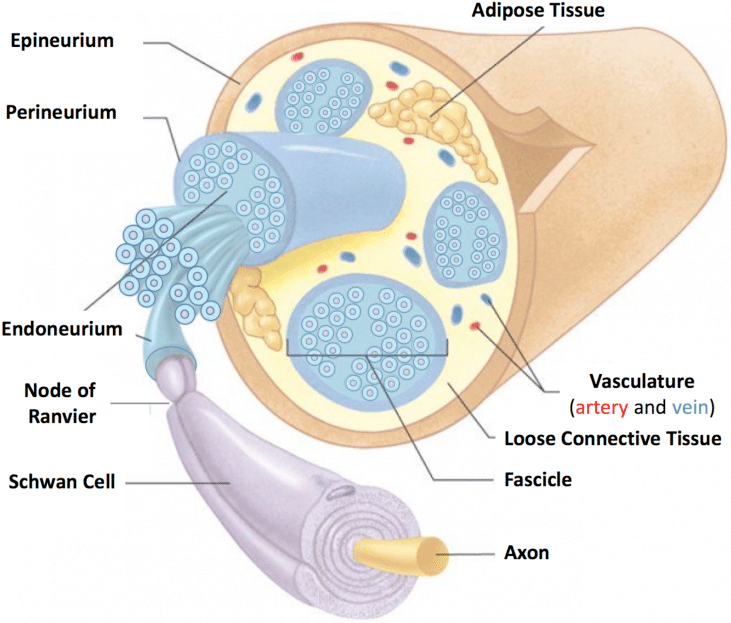
Before I even do this - how common are complications?
Not common. 0.4% - 5%.
I know you want receipts but let’s clarify what a complication is. Check out this fantastic meta-analysis from Gu et al, 2025 in the Journal of Emergency Medicine - where they pooled together data from 53 studies encompassing a total of 2,106 patients, with 79 complication.2 But when they say complication, they mean everything from constipation and failure of the procedure all the way to local anesthetic systemic toxicity (LAST). If you take a look at their data and start removing the number of complications associated with constipation, pruritis, fall, paresthesia, bleeding, and failure; including seizure, agitation, nerve injury, LAST, urinary retention, hypotension, respiratory depression, and nausea/vomiting/dizziness, it’s 59. Take away that last one and it’s 30. Out of 2,106. So they report an aggregate complication rate of 0.05 or 5%. Goldsmith et al, 2024 in JAMA reported 10 out of 2,735 complications, or 0.4%, and when you dig into Table 2, some of these complications seem spurious - one patient with presumed LAST given anxiety and high blood pressure, got intralipid, improved, and on administration of the second dose of intralipid, had the same symptoms and requested cessation of treatment, for which the clinicians assessing had low suspicion this was really LAST; another was hypotensive and somnolent though this could be from a vagal reaction or the fact that the patient had a large thigh hematoma from a fall; another had new numbness and a temporary foot drop and an MRI later revealed they had a malignancy at L4.
So yeah really low. The JEM goes as far to compare standard of care analgesia (morphine, nalbuphine, or ketamine) compared to US guided nerve blocks, with an odds ratio of 0.17, as in the odds of a patient experiencing a complication from your block are 83% lower than standard analgesia.
I touched the nerve with my needle! What now?
Chill. Back up a millimeter or so. If there are even any symptoms, they are transient, and resolve spontaneously.
Take it back now y’all (one hop this time) - this is not uncommon when doing the ultrasound guided peripheral nerve block. The most common symptom is that the patient will feel a strange sensation - the one I’ve heard the most is a “zap” or “lightning” sensation along the nerve distribution. This lasts less than a second, and your job is pretty simple: back up a teeny bit. The goal again is to not puncture the epineurium, and to deposit your anesthetic around it.
Peripheral nerve injury is rare despite the fact that we’re poking around the nerve. It happened a single time in the Goldsmith article, and not at all in the Gu article. Our friends in Anesthesia note this as well - although a high proportion of nerves in this study were punctured or even injected into, not all cases resulted in any apparent clinical injury in this study. In fact, the before procedure and 6 month post procedure sensory and motor testing were the same.3
But let’s say you did poke the epineurium and the patient has ongoing symptoms - how long will these symptoms of pain/paresthesia/dysesthesia last? Less than 48 hours.4 If symptoms haven’t resolved after that, have the patient follow up with a neurologist/pain specialist for electromyography/conduction studies.5
What if I injected into the nerve?
Still ok, but don’t do that.
You should be visualizing your whole procedure on the ultrasound screen, and if your trying to inject anesthetic into a nerve you may meet some resistance - stop. Reposition, and make sure your anechoic anesthetic is going around the nerve instead of inside of it. In Bigeleisen’s article in Anesthesiology, 21 of 26 patients had intraneural injection, and a whopping none of them had any changes on their 6 month post procedure sensory or motor exam. Most cases of any symptoms in intraneural injection resolve without any complications and prognosis is excellent.67
What if I just straight up transect the nerve?
Call your neurosurgeon or peripheral nerve surgeon if you have on.
This is pretty hard to do. You’re visualizing your needle, your needle is usually smaller than the nerve you’re trying to block (unless it’s that damn radial nerve - where are you? Come home.), or you decided to throw out all sense and stuck a knife in there.
Stop the procedure, do a quick sensory and motor exam and get a peripheral nerve surgeon or neurosurgeon to evaluate the patient. This has the worst prognosis compared with the other two injuries above; recovery is dependent on timing and quality of surgical intervention and then involves rehab with PT/OT, long term pain management and monitoring for things like complex regional pain syndrome.8
Alright I’m ready to do this. How do I do an ultrasound guided nerve block?
You must be new here. We don’t do that. Fear only.
Check out the New York Society of Regional Anesthesia (NYSORA), EM:RAP, or the nerve block app. The best way to learn is to find someone who does this a lot, and does it well, and have them teach you.
So should I be afraid of peripheral nerve blocks?
No, but you should be nervous about transection. Ha.
What are you afraid of? What would you like to see on this blog?
Kuliasha CA, Spearman BS, Atkinson EW, et al. ROBUST AND SCALABLE TISSUE-ENGINEERINED ELECTRONIC NERVE INTERFACES (TEENI). 2018 Solid-State, Actuators, and Microsystems Workshop Technical Digest. Published online May 21, 2018. doi:https://doi.org/10.31438/trf.hh2018.13
Gu JH, Cotarelo A, Samarneh M. Complications of Ultrasound-Guided Peripheral Nerve Blocks in the Emergency Department: A Systematic Review and Meta-Analysis. The Journal of Emergency Medicine. Published online February 2025. doi:https://doi.org/10.1016/j.jemermed.2025.02.025
Bigeleisen Paul E. Nerve Puncture and Apparent Intraneural Injection during Ultrasound-guided Axillary Block Does Not Invariably Result in Neurologic Injury. Anesthesiology. 2006;105(4):779-783. doi:https://doi.org/10.1097/00000542-200610000-00024
Lemke E, Johnston DF, Behrens MB, et al. Neurological injury following peripheral nerve blocks: a narrative review of estimates of risks and the influence of ultrasound guidance. Regional Anesthesia and Pain Medicine. 2024;49(2):122-132. doi:https://doi.org/10.1136/rapm-2023-104855
Goldsmith A, Driver L, Duggan NM, et al. Complication Rates After Ultrasonography-Guided Nerve Blocks Performed in the Emergency Department. JAMA Network Open. 2024;7(11):e2444742. doi:https://doi.org/10.1001/jamanetworkopen.2024.44742
McLeod GA, Sadler A, Hales TG. Traumatic needle damage to nerves during regional anesthesia: presentation of a novel mechanotransduction hypothesis. Regional Anesthesia and Pain Medicine. 2022;47(11):703-706. doi:https://doi.org/10.1136/rapm-2022-103583
Fredrickson MJ, Kilfoyle DH. Neurological complication analysis of 1000 ultrasound guided peripheral nerve blocks for elective orthopaedic surgery: a prospective study. Anaesthesia. 2009;64(8):836-844. doi:https://doi.org/10.1111/j.1365-2044.2009.05938.x
Brull R, Hadzic A, Reina MA, Barrington MJ. Pathophysiology and Etiology of Nerve Injury Following Peripheral Nerve Blockade. Regional Anesthesia and Pain Medicine. 2015;40(5):479-490. doi:https://doi.org/10.1097/aap.0000000000000125